
Using Qwiic Peripherals
Qwiic is a standard that makes it easy to connect peripherals to development boards, etc. It uses I2C to extend the functionality of development boards, adding things like sensors, button arrays, joysticks, etc.
Take a look at the products available at shops like SparkFun, Adafruit, etc. for Qwiic-compatible peripherals.
All three Bottango control boards use the default I2C pins for ESP32 microcontrollers (GPIO 21 for SDA and GPIO 22 for SCL), so you should be able to build off of example code for your Qwiic peripheral without too much adjustment. However, you will need to modify the open-source firmware to add support for the peripheral and add the logic for what to do with it.
You could, as an example, use a Qwiic-compatible human presence and motion sensor to trigger animations based on movement. Or, since Qwiic peripherals are daisy-chainable, you could add many more animation trigger buttons by daisy-chaining them together. There’s a whole ecosystem of compatible peripherals, from relays to GPS modules and screens, etc.
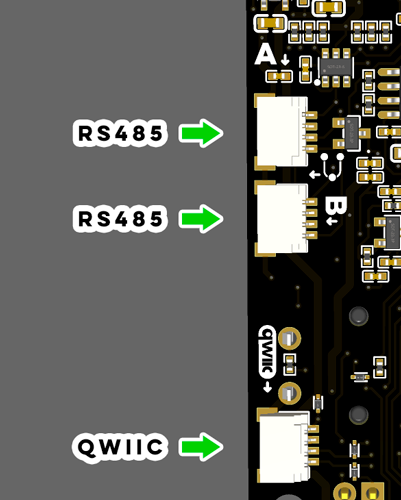
Look on the back of each board. You will find two RS485 board-to-board communication ports and one Qwiic port.
Some example guides to using Qwiic peripherals with Bottango control boards will come in a future revision of this documentation.