
Bridge and Peers
For Bottango control boards to communicate with each other, one board must be assigned the role of “bridge.” The other boards are all “peers” that connect to the bridge.
Any Bottango control board can be a bridge at a technical level. Bottango Nova is the board purpose-designed to fill that role, but Bottango Solar and Bottango Impulse are also able to switch into bridge mode.
Any Bottango control board can connect to a bridge as a peer. You can use wireless connectivity, as we’ll go over in this guide, to connect peers to the bridge. The bridge will create a low-latency wireless access point, and the peers will connect directly to the bridge. You can alternatively use a wired connection to connect peers to the bridge.
You can have multiple networks of bridges and peers in a single Bottango project. However, a peer will only connect to the bridge assigned to it; it cannot connect to multiple bridges.
Additionally, since the Bottango firmware is open source, you can use your own ESP32-based microcontrollers as either a bridge or a peer with the correct firmware customization; you are not limited to Bottango control boards. You can mix and match Bottango control boards with your own custom builds as well. See the firmware guide to relay communication for the custom-hardware workflow.
Example Layout
Section titled “Example Layout”If you had the following:
- 1x Bottango Nova- 1x Bottango Solar- 1x Bottango ImpulseYou would likely choose to have Bottango Nova be the bridge. The Bottango Impulse and Solar would connect to the bridge as peers.
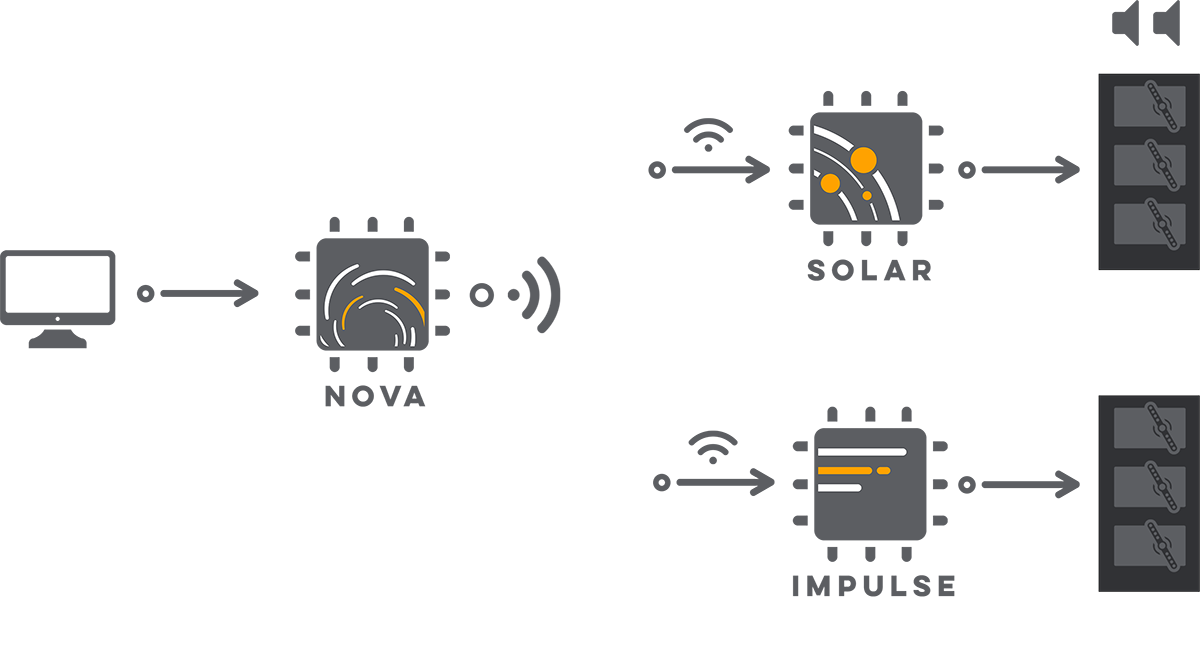
After setting things up following this guide, Bottango Nova would stay connected to your computer over USB, and it would forward commands from the computer wirelessly (or via wired RS485) to the peer boards. If you exported animations to Bottango Nova in this setup, it would serve the animations to the peers as a show controller.
Double Duty Bridge and Motors
Section titled “Double Duty Bridge and Motors”It’s possible for a bridge to also control its own effectors and servos, etc. For example, you could use a Bottango Solar as a bridge while also controlling its own servos, and have a Bottango Impulse connect to the Bottango Solar as a peer.
- 1x Bottango Solar- 1x Bottango Impulse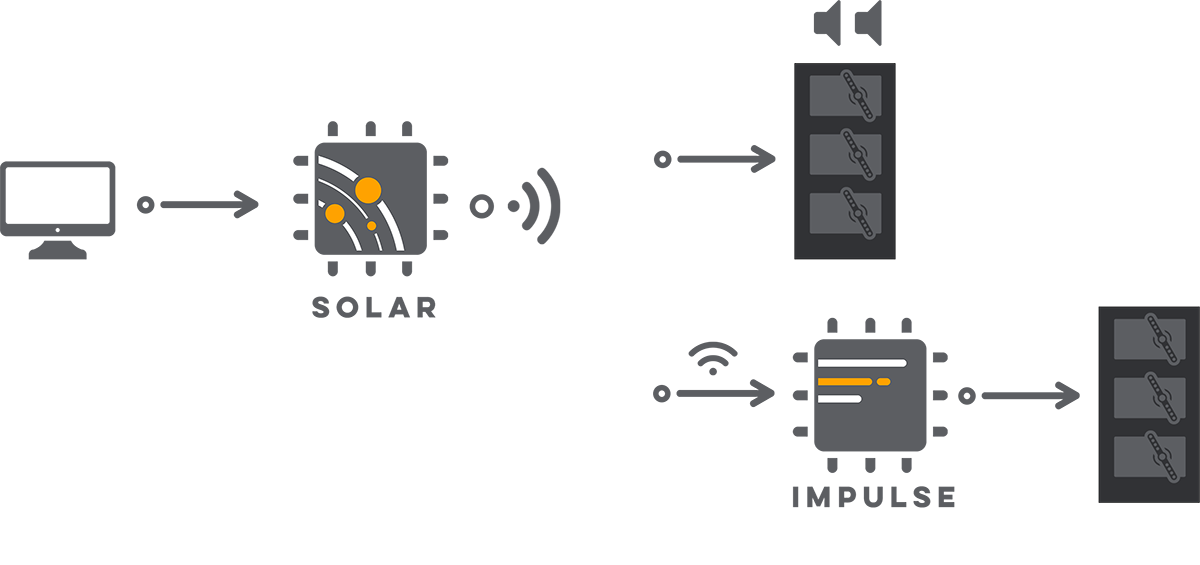
This can work, and it may be the best choice for your project. However, depending on how much work the bridge device is doing to run its own motors and how much latency is involved in wireless communication, it may be more robust to use a dedicated bridge device rather than split duties. The more robust option is usually to use a dedicated bridge device (Bottango Nova recommended), whose primary task is serving animations and running show control logic, but it is not a hard requirement.